Letter Writing
A letter is a written message that can be handwritten or printed on paper. It is usually sent to the recipient via mail or post in an envelope, although this is not a requirement as such. Any such message that is transferred via post is a letter, a written conversation between two parties.
Now that E-mails (Advantages and disadvantages) and texts and other such forms have become the norm for communication, the art of letter writing has taken a backseat. However, even today a lot of our communication, especially the formal kind, is done via letters. Whether it is a cover letter for a job, or the bank sending you a reminder or a college acceptance letter, letters are still an important mode of communication. Which is why it is important that we know the intricacies of letter writing.
Types of Letters
Let us first understand that there are broadly two types of letter, namely Formal Letters, and Informal Letters. But then there are also a few types of letters based on their contents, formalities, the purpose of letter writing etc. Let us have a look at the few types of letters.
- Formal Letter: These letters follow a certain pattern and formality. They are strictly kept professional in nature, and directly address the issues concerned. Any type of business letter or letter to authorities falls within this given category.
- Informal Letter: These are personal letters. They need not follow any set pattern or adhere to any formalities. They contain personal information or are a written conversation. Informal letters are generally written to friends, acquaintances, relatives etc.
- Business Letter: This letter is written among business correspondents, generally contains commercial information such as quotations, orders, complaints, claims, letters for collections etc. Such letters are always strictly formal and follow a structure and pattern of formalities.
- Official Letter: This type of letter is written to inform offices, branches, subordinates of official information. It usually relays official information like rules, regulations, procedures, events, or any other such information. Official letters are also formal in nature and follow certain structure and decorum.
- Social Letter: A personal letter written on the occasion of a special event is known as a social letter. Congratulatory letter, condolence letter, invitation letter etc are all social letters.
- Circular Letter: A letter that announces information to a large number of people is a circular letter. The same letter is circulated to a large group of people to correspond some important information like a change of address, change in management, the retirement of a partner etc.
- Employment Letters: Any letters with respect to the employment process, like joining letter, promotion letter, application letter etc.
STRUCTURE OF LETTERS
- Address Heading
This is the writer’s full address. Business letters usually have preprinted, letterhead stationery which contains this information. An address heading is optional for informal letters. - Date
This is the month, day and year that the letter is written on. - Inside Address
The recipient’s full name and address. Generally, informal letters do not include an inside address.
*Note: Refer to Addressing Persons of Title when writing letters to these people. - Attention
With formal letters, the "Attention: [full name of recipient]" is placed two vertical spaces below the inside address. - Greeting
Also known as the “salutation,” this is the introductory phrase, “Dear [name of recipient].” Either a comma or a colon can be used at the end of this phrase. Today, a comma is more extensively used, with the exception of the use of a title (i.e. “Dear Member:”) and not a proper name. In this case, the use of a colon would be more appropriate.
*Note: Refer to Addressing Persons of Title when writing letters to these people. - Subject line
A word or phrase to indicate the main subject of the letter, which is preceded by the word “Subject:” or “Re:” (Latin for “matter”). Subject lines may be emphasized by underlining, using bold font or all capital letters. They can be alternatively located directly below the "inside address," before the "greeting." Informal or social letters rarely include a subject line. - Body
The complete text of the letter; the subject matter content. - Closing
This is the farewell phrase or word that precedes the signature and is followed by a comma. Closing should reflect a type of farewell or goodbye as the writer signs off. Examples: “Yours truly,” “Sincerely,” “Respectfully yours,” “Regards,” etc.
*Note: "Thank you," is not considered an appropriate closing for a formal or business letter. - Signature
The signed name of the writer. - Identification Line
Formal or business letters include the full name of the writer printed below the signed name (two vertical spaces below the Closing). It includes the writer’s professional designations and title with the organization. Directly below that, the name of the organization which the writer represents. - Postscript
Is a brief sentence or paragraph introduced by the initials, “P.S.” (post scriptus) - Latin for “after having been written.” It implies that the writer, having completed and signed the letter, had an after-thought. Although this is still commonly used in informal letters, it is not widely accepted for use in formal or business letters. - Notation
Part of a formal or business letter consisting of brief words or abbreviations as notations.Examples:
“R.S.V.P.” (Répondez s’il vous plaît) - French for “Please reply.”
The use of this notation indicates that the writer expects the recipient to contact the writer with a “yes” or “no” response to the invitation extended in the body of the letter. Often a corresponding address and/or phone number is printed directly below this notation.“cc:” (carbon copy) - These initials are followed by a name or column of names, indicating those people to whom a copy of the letter is being sent to. (One-sided inked carbon paper slipped between two pieces of paper was once the method used for duplicating copies of correspondence, hence use of the word "carbon" in this notation).
“encl.” (enclosure) - Indicates that something else accompanying the letter is enclosed.
“PL/rm” (initials of persons) - Indicates that a person typed or even composed a letter on behalf of someone else. The capitalized initials are those of the sender of the letter (Paul Lazarman). The lower-case initials are those of the person who typed or composed the letter (Rachel McDonald) on behalf of the sender. The most common use for this notation is for situations where an administrative assistant composed and/or typed the final version of a letter that was dictated by his/her boss.

EXAMPLE OF FORMAL LETTER
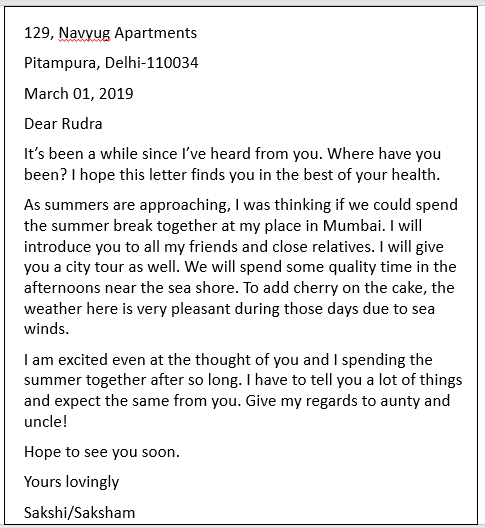
EXAMPLE OF INFORMAL LETTER


Hi!
BalasHapusYour article or information is in accordance with the theme, the writing of the article has exceeded 4 paragraphs, the publication of your blog article is on time, there are already pictures and videos, and there are also conclusions for your theme.
your blog is done!